Vision happens in the mind, not in the eyes. [Marc Maurer]

Monday, March 21, 2016

Alpha One: The Only Thing I Use


I till Alpha One into the soil at planting time, then dress plants with it mid-season.  Here is some information about the stuff from Alpha One's website:


Alpha One Natural Organic Lawn & Garden Fertlizer is manufactured in Colorado for the soils of the Rocky Mountain States.  It has the highest organic matter content of any fertilizer on the market with a homogeneous nutrient blance without the non-essential elements of some fertilizers. Alpha One provides the plant ready natrients in a natural time release for an extended availability for the plant.  The Alpha One formulation enables a uniform leaf growth without teh typical lush growth syndrome following application of commerical fertilizers or some "organic fertilizers" made with nitrogen from chemical sources.  The organic aminor acids of Alpha One counteract the high pH calcareous soils of our Rocky Moutain Region creating a better soil environment for all varieties of turf grasses.  Alpha One contains no manure, sludge or waste.

Product Benefits:

Highest organic matter content
Highest humic acid value
Low pH for Colorado alkaline soils
Granulated for uniform application
Balanced nutrient solubility for controlled nutrient release
Provides mineral and organic nutrients naturally without loss to the environment
No odor
No heavy metals
No salts
Non-toxic
Non-burning
Non-staining

Contents:  Alfalfa, Blood Meal, Cottonseed Meal

Source:  www.alphaoneinc.com

Monday, June 30, 2014

The North Wing

Gaillardia aristata (Native Blanket Flower) and
Stanleya pinnata (Prince's Plume) steal the show


Monday, May 26, 2014

Garden Tour Caveat

My dryland garden will be one of eight gardens showcased in this year's Wheat Ridge Garden Tour on Saturday, July 12.  WARNING:  This suburban front yard horticultural collage is a work in progress and is completely devoid of fairies, blown glass mushrooms, sundials and tin sculptures!  It is, however, an example of how to transform a large patch of lawn on a sunny and arid southeast corner (with the help of a only a little well water) into a tapestry of blues, greens, silvers and greys; xeriscape without an over-reliance on monochromatic humps of gravel and cacti. This summer's tour is later in the year so the bees' buzzing will be in full effect!  Stop by anytime between 8:00 a.m. to 2:00 p.m., on bicycle if you like.  Visit www.wheatridgegardentour.com for details.

Eurotia Lanata, case in point 

Succulents Love Snow


Sedum looking like some fabulous sea creature
Mother's Day Weekend, 2014

Sunday, February 9, 2014

Winter Texture

Panicum in Sun
(click to enlarge)
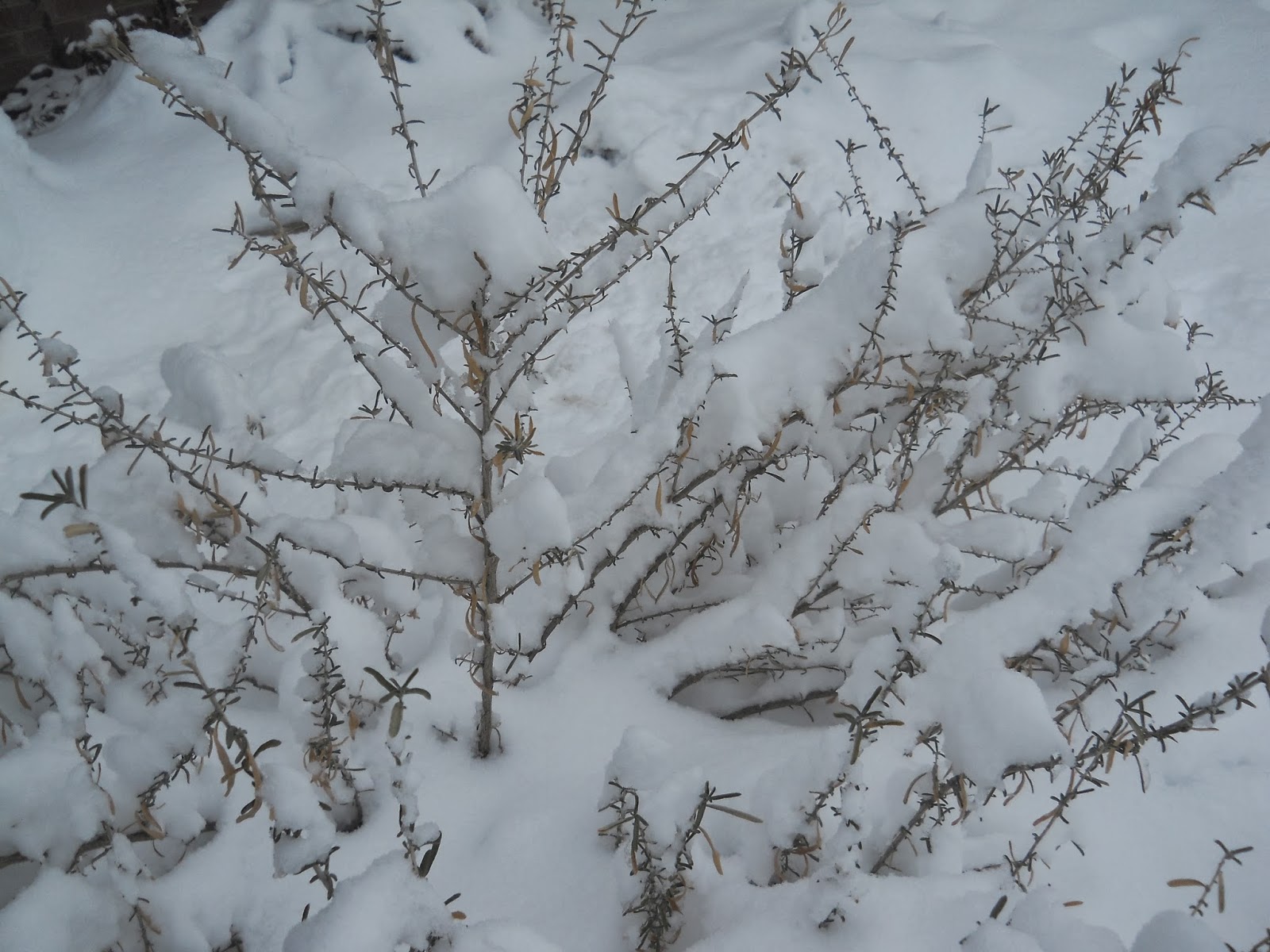
Rabbitbrush Sno-Cones
(click to enlarge)

Sunday, February 2, 2014

Salt of the Earth

Atriplex canescens
Since there are no cattle roaming the neighborhood, this plant has survived several winters, and morphs into a new sculptural form with every season.  Four-winged Saltbush (a.k.a. saltsage, wafer sagebrush, buckwheat shrub, chamiza) is valued as a forage plant.  For us suburbanites, it lends structure to the dryland garden in winter.  I wonder if I will like it as much once it reaches its estimated height and width of five feet...

Saturday, June 22, 2013

The Oxymoron of Prickly Buns

Click once on the picture to view a larger image
They don't call it Prickly Thrift for nothin'.  Acantholimon is the Latin name, borrowing from the Greek word akantha, or thorn (I only know this because I purchased my first pair of reading glasses today and was thus finally able read the definition in my new Latin for Gardeners book, which had up until then been lying around, mostly unopened, since Mother's Day).  Contrasting with Acantholimon's thorniness is the mound-like shape and delicate, soft pink blossoms.  The garden is replete with such dichotomies!  This corner site adjacent to the sidewalk is basically a sand bed (also greatly appreciated by Eriogonum jamesii).  Turns out in Wheat Ridge our soil is equal parts of sand and silt, not mostly clay as I had initially thought.  No wonder the soil was pretty easy to crack through that first year.  Thanks to Kenton Seth for so freely sharing this plant!

Monday, June 17, 2013

A Mind of One's Own

Click once on the picture...
This Four-Winged Saltbush did not look like this a month ago.  It looked boring and grey and lackluster, its twiggy branches barely covered with puny and brittle leaves.  Nothing a little pruning by an amateur with dull tools couldn't fix! I cut half of it off (the dead-looking part) and almost right away it leafed out beautifully.  It has even started to take on the contour of the irregularly-shaped plot of soil in which it sits! Jim Borland says not to plant these, and especially not to prune them, lest you have an untameable beast on your hands!  My interpretation of this was "Great, I'll put one of those right next to the front door!"  I guess part of my emerging philosophy is that one must throw caution (and good advice) to the wind and try things out for oneself...

Wednesday, June 5, 2013

Three Dryland Favorites

Click on the picture to see a larger image
Gutierrezia sarothrae (Broom Snake Weed) is bright green, waves in the breeze like an ornamental grass, and is especially lush-looking this year with all the spring rain.  Tiny yellow flowers will arrive mid-summer.
Click on the picture to see a larger image
Though Amsonia jonesii is also known as Colorado Bluestar, its blooms are decidedly lavendar, especially in contrast to neighboring Linum (Blue Flax), below.
Click on the picture...

Thursday, May 30, 2013

Emergence of Color

Penstemon alamosenesis, Artemisia filifolia,
Eriogonum corymbosum (still just a youngen!)
and Amsonia  jonesii

Click on the picture to see a larger image

Saturday, May 4, 2013

Space

The temptation to fill up the space is ever-present, both in life and in the garden.  For now I'm practicing delighting in the openness in the front yard, the brand new extra three hundred square feet of it, rather than rushing out to empty my wallet at the local garden center (this sort of emptiness is all to familiar...).  Today I went to the May Day celebration at Harlequin's and had enough self restraint to walk away with three plants.  Tomorrow I'll plant Amelancheir alnifolia, Zinnia grandiflora and another Gutierrezia sarothrae, my favorite native as of late.

Sunday, March 10, 2013

Forgetfulness

I can't worry about this too much, the fact that the agave appears to be dead (the leaves are white and floppy at the base). It didn't appreciate having had snow heaped on top of it for several days.  I've known this about agaves, but temporarily forgot.  When I came out of my amnesia, I'd had enough sense to carefully remove about six inches of snow from the top.  The crown did not care for the snow that remained there for several more days, ending up ruined. Good thing the plant had sprouted several pups last summer.

Saturday, November 10, 2012

Himalayan Fleece Flower

Some of the most gorgeous color I've seen this fall was spotted a couple of Sundays ago at DBG. Polygonum affine (Persicaria affinis) glowed like fire in the morning sun! I would love to see this plant in its natural habitat (China, Tibet), but of course would settle for a clump of it in my own garden.

Sunday, October 21, 2012

Smiling Asters

Next year I will cut this Aster plant back several times to avoid the legginess seen this year, which I've lassoed in with a thick piece of twine. Bees are still afoot in my garden thanks to it. The above shot was taken in the late afternoon shade, the below one in mid-morning light. What beautiful little faces in those flowers!

Friday, October 5, 2012

Veneer of Snow

Things sure do turn on a dime around here.

Wednesday, October 3, 2012

Autumn Light

Since the arrival of fall, I'm convinced the Porter Plains Garden is my favorite garden at Denver Botanic Gardens (DBG). The grasses, rabbitbrush, broom snakeweed, Helianthus and asters sway in the breeze, relfecting the golden autumn light.

Friday, September 21, 2012

'Til Next Year

Summer on its way out, many of my long-blooming gems are still going. The plant budget dried up, so I'm working on tolerating the gaps, rather than running out to fill them. Looking at this thumbnail, the pink rocks near the Hybrid Crane's Bill need to go. I'm digging the blues in the background, warm colors up front, and threads of gold throughout. One can't go wrong limiting the palette to primaries.

Saturday, September 15, 2012

Greyish Green and Gold

Lately the combination of greyish green and gold in my garden is captivating, especially in the late afternoon. A cascade of Chrysothamnus nauseosus var. nauseosus, spreading mound of Gutierrezia sarothrae, and Artemesia filifolia and A. arborescens shimmer in the late summer light. Here, Agave parryi v. neomexicana (with Agave parryi truncata and Chrysothamnus in the background) will soon show off its reddish tips from beneath our first fall snow.

Sunday, August 26, 2012

Ripe

This Opuntia in the dryland garden at DBG was absolutely gorgeous in full sun today. If I had the patience I would sketch it then paint it in gouache.

Wednesday, August 22, 2012

Rabbitbrush in Bloom

What a sight this sea of rabbitbrush is, adjacent to Crown Hill Park in Wheat Ridge. A signal that fall is fast approaching!  A choice specimen, below, at the Kendrick Lake Demonstration Garden in Lakewood is a like a gold shag carpet.  The Chrysothamnus nauseosus (bottom) in my own garden will need another few weeks to come into full form.